Precious Metals Fund - Q3 2026 Letter
Dear Partners and Friends,
PERFORMANCE
The Equinox Partners Precious Metals Fund rose +19.6% in the third quarter and is up +21.1% for the year to date. By comparison, in the third quarter, the price of gold ticked up +2.8% and the MVIS Junior Gold Mining Index rallied +16.8%, finishing the year to date through Q3 down -3.8% and up 0.3% respectively.
Performance for the quarter was driven by our producing miner portfolio, and most notably our largest holding, Solidcore Resources, which rose +60%. In September, Solidcore announced a tender offer to buy back over 23% of its shares outstanding, and in early October the company confirmed the entire offer had been tendered. Other notable sources of outperformance in the quarter were our investments in producers such as B2Gold, DPM Metals, and Discovery Mining. The exploration-stage segment of the portfolio rallied +10%, lagging the move in the MVIS Junior Gold Mining Index.
Portfolio Activity
In the third quarter, we initiated three new pre-production positions and added to five of our existing portfolio companies. We fully exited two portfolio companies, including Omai Gold Mines, at a substantial profit. We also continued to trim two of our West African producing gold miners. In mid-2024, our Africa exposure was over 40% portfolio weight. Today our exposure to Africa is less than 15%. This reduction has been offset by our increasing exposure to companies in Kazakhstan and Canada.
Site Visits
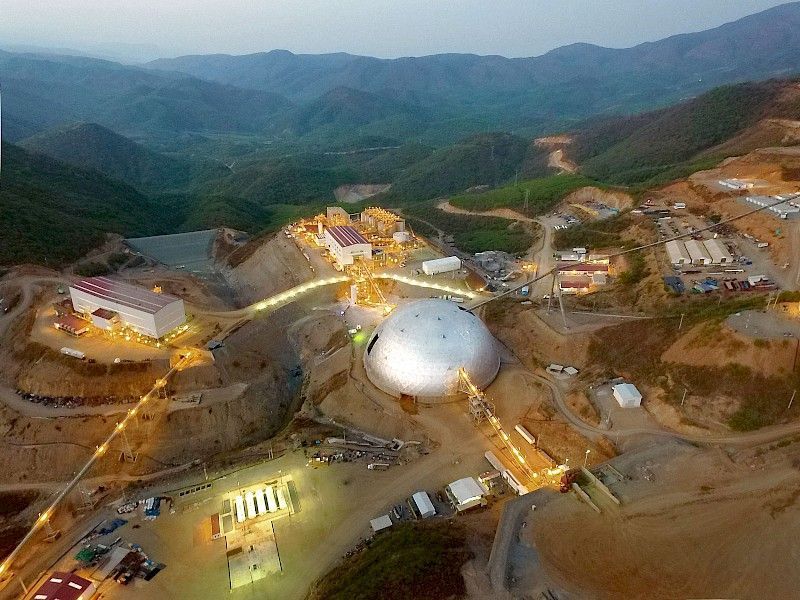
The mining research team has been traveling extensively in recent months. We have conducted mine site visits to portfolio company projects in Papua New Guinea (K92 & New Pacific), Kazakhstan (Solidcore, Arres & Pallas), Northern Territories of Canada (B2Gold). We also attended a series of mining conferences in Colorado where we spent time with the management teams and directors of several of our investments. We remain high-conviction gold mining investors given our federal government's failure to control spending. In the letter that follows, we will discuss the politics of America's ballooning debt.
The Changing Politics of America's Government Debt
“How did you go bankrupt?”
“Two ways. Gradually, then suddenly.”
Ernest Hemingway, The Sun Also Rises
America’s federal government is in the gradual phase of bankruptcy. Our fiscal path is unsustainable, but it remains unclear when we will be forced to change. The Japanese ran their government debt-to-GDP ratio over 200% without a crisis. So, with America’s federal debt-to-GDP at a mere 123%, our politicians continue to spend as if deficits don't matter.
Conventional wisdom on Wall Street holds that the Treasury market will dictate the timing of the ultimate solution. When the federal government can't roll over its debt on acceptable terms, politicians will act. But, even when that moment arrives, the crisis will be manageable. The Treasury and Federal Reserve will both buy Treasury bonds to maintain order in capital markets while politicians work out a solution.
We are less sanguine about the contours of America’s debt endgame. The current turmoil in France is a reminder of just how toxic the combination of over-indebtedness, social unrest and a presidential election cycle can be. There are an uncomfortable number of similarities between the current situation in France and America. Like France, America is socially and politically divided. Like France, cost-of-living increases are the top political issue in the U.S. And, like France, America has an upcoming presidential election which could usher in meaningful policy change.
In France, the twilight of Macron’s 10-year presidency prompted serious political proposals. Marine Le Pen, currently leading the polls with 35% of first-round votes, has proposed reducing government spending by €140 billion cumulatively over the next six years. And, her most plausible challenger, Jean-Luc Mélenchon, has proposed simply writing off the French debt held by the French Central Bank.
America’s presidential election cycle begins next Wednesday, promptly after the November midterms. We expect Americans aspiring to the presidency will also float a variety of serious fiscal proposals. The ideas will likely include everything from a wealth tax to means-testing Social Security. At this moment, it’s not the specifics of the proposals that matter as no one credible is likely to propose radical spending cuts. Rather, it is the political appetite to do something, a calculation that stands in stark contrast to the political wisdom in America’s last three presidential election cycles.
In 2016, with America’s national debt-to-GDP at just 105% ($20 trillion at the time), our debt crisis didn’t yet appear politically ripe for solving. In 2020, the COVID crisis and related emergency spending drowned out any discussion about America's unsustainable fiscal path. And, most recently, in the 2024 election, Trump was able to dismiss out of hand questions about the fiscal deficit, while Joe Biden and Kamala Harris were forced to focus on their competence to serve as president. As such, America has gone through ten long years without serious discussion about our fiscal situation. America's 2028 political cycle will likely prove a turning point in this regard, just as the 2027 election is proving to be a turning point for France.
As our 2028 cycle heats up, markets will likely conclude that something is going to happen and will begin to discount the looming policy shock. It is also likely, in our opinion, that a Democratic-controlled Congress, in cooperation with a lame-duck President Trump, will take a stab at America’s fiscal problem preemptively. Trump is not one to punt on hard decisions, and his Treasury Secretary Scott Bessent is on the record stating that he took the job because he wants to participate in a global economic reordering. He may soon get the chance.
Organizational Update
In September, we added Will Robinson to our investment team. He joins us from Sixth Street Partners, where he was an associate on their Infrastructure investment team. Will originally hails from Texas, outside of Dallas, and received a B.B.A. in Finance from The University of Texas at Austin. We are excited for him to bolster the analytical horsepower of our mining research.
Sincerely,
Equinox Partners Investment Management
[1] Please note that estimated performance has yet to be audited and is subject to revision. Performance figures constitute confidential information and must not be disclosed to third parties. An investor’s performance may differ based on timing of contributions, withdrawals and participation in new issues.
Unless otherwise noted, all company-specific data derived from internal analysis, company presentations, Bloomberg, FactSet or independent sources. Values as of 9.30.26, unless otherwise noted.
This document is not an offer to sell or the solicitation of an offer to buy interests in any product and is being provided for informational purposes only and should not be relied upon as legal, tax or investment advice. An offering of interests will be made only by means of a confidential private offering memorandum and only to qualified investors in jurisdictions where permitted by law.
An investment is speculative and involves a high degree of risk. There is no secondary market for the investor’s interests and none is expected to develop and there may be restrictions on transferring interests. The Investment Advisor has total trading authority. Performance results are net of fees and expenses and reflect the reinvestment of dividends, interest and other earnings.
Prior performance is not necessarily indicative of future results. Any investment in a fund involves the risk of loss. Performance can be volatile and an investor could lose all or a substantial portion of his or her investment.
The information presented herein is current only as of the particular dates specified for such information and is subject to change in future periods without notice.