Equinox Partners, L.P. - Q2 2018 Letter

Dear Partners and Friends,

PERFORMANCE & PORTFOLIO

Equinox Partners declined -4.4% in the second quarter of 2018. Through July 30, the fund was down -16.7% for the year to date.
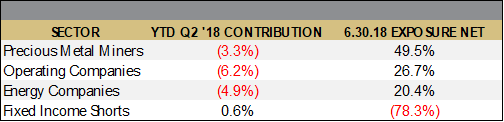
[1]

While our fund has performed poorly for the year to date, the companies we own are performing well. Accordingly, the valuation of our portfolio is compressing. As of June 30, our operating companies were trading at 12.7x estimated ’19 earnings, our mining companies at 3.7x estimated ’19 cash flow, and our energy companies at 4.6x estimated ’19 cash flow. During the second quarter, we purchased two precious metals miners, a bank in Georgia, an energy company operating in the U.S., and sold short a U.S. tech company.  We also exited a Mexican mining company and reduced our operating company long exposure from 32.5% to 28.7%.

gold


           “Even if it works, you’re a jerk.” — Charlie Munger on gold


Conventional wisdom is that gold investors hope bad things will happen. They pine for a trade war, uncontained inflation, central bank missteps, or more or less anything awful that will drive investors to buy gold in droves.  Gold investors not only hope for the worst but are incapable of appreciating the progress humanity has made, which is why they cling to their antiquated monetary technology.  In Munger’s opinion, this antisocial worldview is so distasteful that it merits opprobrium even if proven right.


Needless to say, we disagree with Munger. The gold investors we know, like more or less everyone else, hope for the best. But, unlike most everyone else, gold investors refuse to believe in the end of financial history.  For gold investors, there is nothing novel about government efforts to free our financial system from the credit cycle.  Financial history is replete with such attempts. Financial history is also replete with their failure and evidence that these noble undertakings tend to fail spectacularly just when the ever-upward slope of progress seems to be a foregone conclusion.   


As global investors, we are regularly reminded that progress is not linear and that the economic cycle has not been repealed.  This conviction comes from having lived through more economic cycles than most domestic investors even notice.  From the Asia Crisis of 1997, to the Russia Crisis of 1998, to the end of the Real Plan in 2002, to the Argentine Crisis of 2006, to the European Bond Crisis of 2011, to the Turkey Crisis of 2018, we see no evidence that economic cycles are a thing of the past. Moreover, our analysis of these crises reveals two common ingredients: over confidence and over leverage—two qualities that the developed world currently has in spades. 


Economic cycles, which remain an accepted fact of life in emerging markets, are increasingly viewed as an avoidable policy error in the developed world.  It is almost as if there are two types of countries which are fundamentally unequal. There are countries that remain subject to cyclical vagaries, and there are a handful of core developed world countries subject to a new set of more benign economic rules. Chief among these new rules is that financial stress always benefits the core. This is true even if the stress originates in the core. For example, were the United States to run a large, pro-cyclical fiscal deficit, it would place stress on the U.S. Treasury market which in turn would put even more stress on foreign dollar borrowers which would drive a flight to safety which would in turn buoy the U.S. Treasury market.


While we certainly appreciate the well-worn trading patterns underlying these new economic rules, we are quick to point out that the developed world’s elevated status in global capital markets is not a result of superior policy making.  Rather, at its heart, the developed world’s privileged status stems from its ability to take on ever more debt without spooking creditors.  This accident waiting to happen, in our opinion, has now gone on so long that many observers actually mistake it for progress.  But, why, we ask, must progress involve quite so much debt?  Why, for example, nine years into a global, synchronized economic expansion must the world add $8 trillion of debt in a single quarter? From our perspective, this continued reckless accumulation of debt does not signal uninterrupted progress, but instead a deeply destabilizing force with which few market participants are inclined to grapple. Dave Rosenberg’s commentaries, to his credit, have been an exception to this rule:


This entire cycle was built on a mountain of debt that likely never does get repaid, but has to be serviced nonetheless.  Consider that at the peak of the last credit bubble, the level of outstanding debt at all levels of society – household, business, and government – totaled $27 trillion or about 225% relative to GDP. Fast forward to today and that number has soared to nearly $50 trillion or 250% of GDP. So look at what happened – the USA merely added more debt to an existing debt bubble. For all the bravado about this long cycle we have enjoyed, it was accomplished on a credit bubble that makes what happened in the 2002-07 mortgage mania look like a walk in the park. The main message being that the economy is more susceptible today to even moderately higher interest rates, which is what we are now experiencing, that at any other time in modern history.  Just remember – interest rates exert peak impact with lags.  My advice therefore is to not extrapolate what we just saw in the second quarter GDP report, but to instead treat it as a fond memory.

-         Breakfast With Dave, July 31, 2018

[2]

Amidst this rapid increase in debt, it is galling, but not surprising, that the Federal Reserve has chosen to champion its commitment to financial stability.  Galling because if there is one thing a central bank should do to maintain financial stability it is to contain system-wide debt.  After all, if adding more debt was a sustainable way to achieve financial stability, why didn’t central bankers of the past also pursue this course? The flippant answer is that in the past the bond market wouldn’t let them. The more troubling answer is that past central bankers weren’t arrogant enough to believe that they could subdue the economic cycle or brazen enough to paper over downturn after downturn knowing full well that the resulting increase in debt would inevitably cause a larger future problem.


The age-old tradeoff between pain today in lieu of more pain tomorrow now seems passé, but this tradeoff was largely why central banks of the past accepted or even initiated recessions.  They knew that as painful as a recession might be that financial retrenchment was sounder than the alternative.  Today’s central bankers, by contrast, argue that the right policy can simultaneously optimize employment, inflation, and financial system stability indefinitely.  Seasoned investors sense that not only is this too good to be true but the effort to achieve this combination of outcomes will eventually create problems that even central bankers cannot solve. That said, after a decade of central bankers’ successful management of the economic cycle, most investors have given up waiting for the eventual failure of their policies.


For those who have not given up, gold is just one among many ways of registering disbelief in the sustainability of the status quo. So, why are gold investors singled out for criticism by Munger and others? 


Trivially, short-sellers and traders of derivatives are buying what Wall Street is selling.  So, while they don’t agree with the consensus, they are still participating in the financial ecosystem. Gold investors, by contrast, are signaling that something is wrong not just with asset prices but with the financial system itself.  For many, this is seen as unhelpful.  It is one thing to say that financial assets are overvalued, it is an entirely different thing to say that the very structure of the market is deeply flawed, with the latter offense being antisocial enough to merit condemnation even if it is right.
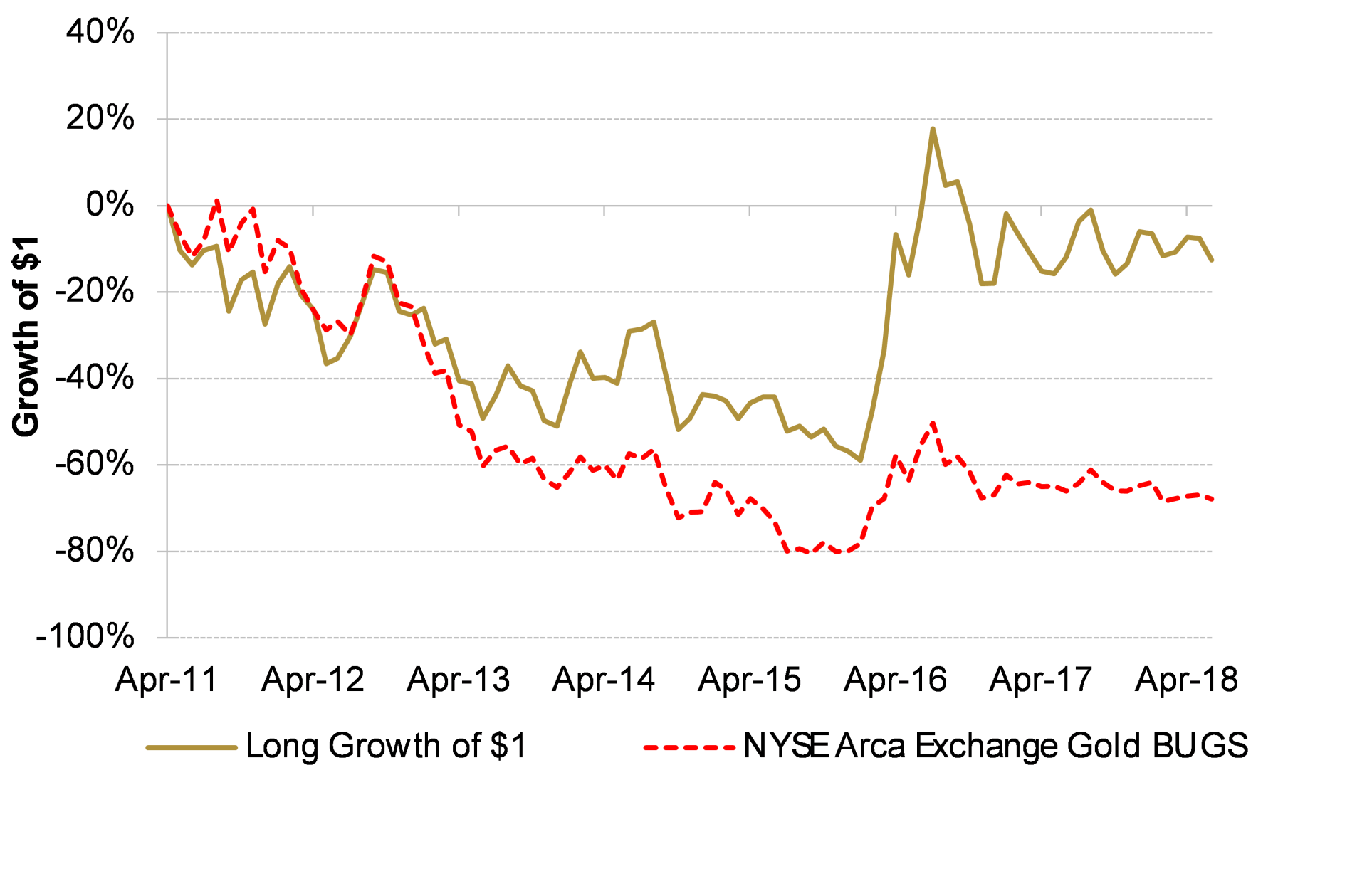
Equinox Partners, of course, owns no gold, only gold and silver mining companies.  As we’ve written before, this strategy has enabled us to add value while we wait for gold’s unique financial attributes to regain wider appreciation. While the topline results of our mining investments have been disappointing, we’ve undisputedly added value over the past seven years.  Specifically, from its monthly peak in 2011 through June 30, 2018, the gold mining stock index (HUI) has declined 67.6%. Over that same period, our gold and silver investments are down just 12.5%.

[3]

Having preserved our partners’ capital through the depths of an extended and severe bear market in gold and silver mining companies, we are particularly well positioned to benefit from a recovery in the sector. Most notably, the long-term partnerships we’ve developed with the better-managed, better-governed companies that have resulted in our outperformance in the ongoing bear market in precious metals miners should also translate into our outperformance in the next bull market.


Sincerely,


Sean Fieler        Daniel Gittes


end notes

[1] Sector exposures shown as a percentage of 06.30.18 pre-redemption AUM. Performance contribution derived in US dollars, gross of fees and fund expenses. Interest rate swaps notional value and P&L included in Fixed Income. P&L on cash excluded from the table as are market value exposures for derivatives. Unless otherwise noted, all company data derived from internal analysis, company presentations, or Bloomberg.  All values as of 06.30.18 unless otherwise noted.


[2] IIF, Global Debt Monitor – July 2018


[3] The junior gold mining index, GDXJ, by comparison, is down 76.9% from its month-end April 2011 peak through June 30, 2018. 
By Kieran Brennan November 11, 2025
Value Investor Insight Profile with Sean Fieler and Brad Virbitsky
By Kieran Brennan October 31, 2025
Dear Partners and Friends, PERFORMANCE Equinox Partners Precious Metals Fund, L.P. rose +36.2% in the third quarter of 2025 and is up +90.2% for the year-to-date 2025. By comparison, the Junior Gold Mining Index GDXJ rose +46.6% in the quarter and is up +132.7% for the year-to-date. Exploration stage companies were the best performing segment of the portfolio, appreciating +55.0% in the quarter. The spot gold price rose +18% in the quarter and is up +47% for the year-to-date. The letter that follows provides our thoughts on the outlook for the gold price and implications for the portfolio holdings. gold The gold bull market, initially driven by central bank buying, has evolved into an investor-driven dollar debasement trade. This second phase of the gold bull market is more explosive than the first because it draws on the approximately $470 trillion of the world’s wealth as opposed to the roughly $35 trillion of central bank balance sheets. If President Trump fans the dollar debasement fire by forcing a politicized Fed to cut rates, gold could rapidly displace the dollar as the world’s reserve currency. However, if President Trump takes a more nuanced approach to the Fed, gold should still displace the dollar as the world’s reserve currency over time with the competition between gold and the dollar taking longer to play out. Gold investors warning about fiat currency debasement is nothing new. That, after all, is why gold investors own gold in the first place. There’s also nothing new about most American investors ignoring these warnings. The dollar’s relative stability has long made concerns about dollar debasement appear quixotic. Since the early 1980’s, American inflation has been largely tolerable, the dollar has outperformed almost all other fiat currencies, and U.S. government bonds have been the safest asset to own in an economic downturn. The dollar has sloughed off so much criticism for so long that Janet Yellen likely did not imagine the chain of events that freezing Russia’s foreign exchange reserves would set into motion. With confidence in the dollar’s inertia and a bit of hubris, in our opinion, Secretary Yellen engineered the freezing of $300 billion of Russia’s foreign exchange reserves and put the world’s central banks on notice that their use of dollar reserves depends upon the tacit approval of the U.S. Treasury. Foreign governments, shocked by this policy change, sought to reduce their dependence on the U.S. Treasury and doubled their gold purchases to roughly $60-80 billion per year (potentially $100 billion in 2025). This increase in central bank gold demand drove the gold price up over +50% from March 2022 to March 2025. This bull market, in turn, gave gold the additional scale necessary to function as a more viable alternative to the dollar and damaged the dollar’s air of invulnerability. This two-fold outcome is problematic because inertia and a lack of alternatives were fundamental to the dollar’s stability. On the back of gold’s appreciation, long-ignored arguments of gold investors began sounding more plausible. Financial professionals accustomed to deriding gold investors and referring to them as insects began to worry that gold’s price action is telling them something important. Jamie Dimon aptly summed up the change of heart: “This is one of those times where it is semi-rational to own gold.” His comment captures both his continued distaste for gold and his willingness to own it. Despite the broadening acceptance of gold as an investment, markets remain skeptical of the underlying dollar-devaluation narrative. Inflation, a broad measure of the dollar’s strength, is just 2.8%. The 10-year U.S. Treasury yields 4.0%, indicating the bond market’s indifference to the dollar debasement narrative. Furthermore, the decline in the trade weighted dollar has partially reversed since early July. At this moment, the dollar debasement trade appears to be waiting for additional macroeconomic and geopolitical events to play out. Of these, none looms larger than President Trump’s effort to bend the Federal Reserve to his will. In January, the Supreme Court will likely allow President Trump to remove Federal Reserve Board Governor Lisa Cook, making the selection of the next Fed Chair even more important. If Trump nominates a loyalist like Kevin Hassett who appears more committed to pleasing the President than price stability, we could see broadening concern about the dollar’s store of value and a growing asset allocation into gold. In this hyper-politicized Fed scenario, gold could quickly become a $100 trillion dollar asset and displace the dollar as the world’s reserve currency. However, if Trump nominates an institutionalist like Chris Waller, the dollar debasement trade will likely remain in limbo for a while as markets suss out how much control Trump really has over the Fed. Either way, the U.S. bond market will not be allowed to freely adjudicate the outcome at the Fed. We expect both Treasury and Fed to proactively manage the yield curve during the particularly politically sensitive period when the Fed is cutting rates while inflation is above their stated 2% target. Treasury will keep longer-dated bond issuance to a minimum while coercing banks to keep the Treasury market well bid. JP Morgan increased its holdings of Treasuries by $80 billion in the first half of this year, and we expect other banks to follow suit. The Fed, for its part, has announced an end to quantitative tightening and its intention to shift its balance sheet from mortgage-backed securities to Treasuries. Given the likely extent of the coordinated intervention of the Treasury and Fed, the bond market will not be a good indicator of the market’s confidence in Trump’s economic policies. Gold will be. To the extent that investors sense that the bond market is not providing a reliable price signal, they will begin paying more attention to gold. And, should the gold price becomes the accepted indicator of U.S. financial health, the Trump administration will take action to influence it. At the very least, this will entail the Trump administration encouraging other central banks to stop buying gold or even sell gold. But the anti-gold policy options are limitless. Needless to say, the U.S. government pushback on gold will not solve the dollar’s long-term structural problems. Nor will it mark the end of gold’s challenge to the dollar. It will simply mark the next phase of financial repression. Our Gold Mines The second phase of the bull market in gold has been broadly positive for our portfolio, as a portion of the investor money flowing into gold has bid up gold mining equities as well. Where central banks buy the physical gold bullion, private wealth investors allocating to gold will also buy gold mining stocks. The GDXJ Junior Mining Index is up +132.7% for the year-to-date through September 30. Even with this year’s rapid rise in the gold mining portfolio, valuations remain cheap at spot gold prices. Our in-production portfolio trades at a 24.0% IRR as compared to a 23.4% IRR on March 31. The most dramatic mis-valuation among our gold miners continues to be in the pre-production companies. While these equities have appreciated more rapidly than our producing companies for the year-to-date 2025, they began from such a low valuation that even at twice or three times their January price, they are still undervalued. Troilus Gold, a junior gold mining company with an 11.2 million ounces gold-equivalent resource in Quebec, Canada, is a case in point. Troilus Gold shares have more than tripled in 2025, rising from C$0.31 to C$1.35 per share. The company still trades at an IRR of 30%, 0.2x price-to-NAV (using a 10% discount rate), and a price per ounce of recoverable gold of $63. When Troilus goes into commercial production in 2029, we expect it will generate annual net income roughly equal to its current market cap. Troilus historically traded at an extremely low valuation because the market did not believe that the company could finance the project's upfront capital expenditure of $1.3 billion. Throughout 2025, Troilus began addressing these financing concerns by signing an offtake agreement with a European smelter and a related letter of intent for $700 million of debt financing on attractive terms. If Troilus Gold raises the necessary equity and signs a streaming arrangement to fully fund the mine’s construction, we believe the stock will trade much closer to its NAV (using a 10% discount rate and the spot gold price) of $2.5 billion.
By Kieran Brennan October 30, 2025
Dear Partners and Friends, PERFORMANCE Equinox Partners, L.P. rose +24.5% net of fees in the third quarter and is up +54.4% for the year-to-date 2025. By comparison, the S&P 500 index rose +8.1% in the third quarter and is now up +14.8% for the year-to-date 2025. Our quarterly performance has been almost exclusively driven by our gold and silver miners. In the third quarter, the spot gold price rose +18%, and the fund’s mining portfolio returned +40%. As of this writing, 78% of Equinox Partners’ capital is invested in the gold and silver sector. The letter that follows provides our thoughts on the gold price and our gold mining holdings. Gold The gold bull market, which was initiated by central bank buying, has evolved into an investor-driven dollar debasement trade. This second phase of the gold bull market is more explosive than the first because it draws on the approximately $470 trillion of the world’s wealth as opposed to the roughly $35 trillion of central bank balance sheets. If President Trump fans the dollar debasement fire by forcing a politicized Fed to cut rates, gold could rapidly displace the dollar as the world’s reserve currency. However, if President Trump takes a more nuanced approach to the Fed, gold should still displace the dollar as the world’s reserve currency over time with the competition between gold and the dollar taking longer to play out. Gold investors warning about fiat currency debasement is nothing new. That, after all, is why gold investors own gold in the first place. There’s also nothing new about most American investors ignoring these warnings. The dollar’s relative stability has long made concerns about dollar debasement appear quixotic. Since the early 1980’s, American inflation has been largely tolerable, the dollar has outperformed almost all other fiat currencies, and U.S. government bonds have been the safest asset to own in an economic downturn. The dollar has sloughed off so much criticism for so long that Janet Yellen likely did not imagine the chain of events that freezing Russia’s foreign exchange reserves would set into motion. With confidence in the dollar’s inertia and a bit of hubris in our opinion, Secretary Yellen engineered the freezing of $300 billion of Russia’s foreign exchange reserves and put the world’s central banks on notice that their use of dollar reserves depends upon the tacit approval of the U.S. Treasury. Foreign governments shocked by this policy change sought to reduce their dependence on the U.S. Treasury and doubled their gold purchases to roughly $60-80 billion per year (potentially $100 billion in 2025). This increase in central bank gold demand drove the gold price up over +50% from March 2022 to March 2025. This bull market in turn gave gold the additional scale necessary to function as a more viable alternative to the dollar and damaged the dollar’s air of invulnerability. This two-fold outcome is problematic because inertia and a lack of alternatives were fundamental to the dollar’s stability. On the back of gold’s appreciation, long-ignored arguments of gold investors began sounding more plausible. Financial professionals accustomed to deriding gold investors and referring to them as insects began to worry that gold’s price action is telling them something important. Jamie Dimon aptly summed up the change of heart: “This is one of those times where it is semi-rational to own gold.” His comment captures both his continued distaste for gold and his willingness to own it. Despite the broadening acceptance of gold as an investment, markets remain skeptical of the underlying dollar-devaluation narrative. Inflation, a broad measure of the dollar’s strength, is just 2.8%. The 10-year U.S. Treasury yields 4.0%, indicating the bond market’s indifference to the dollar debasement narrative. Furthermore, the decline in the trade weighted dollar has partially reversed since early July. At this moment, the dollar debasement trade appears to be waiting for additional macroeconomic and geopolitical events to play out. Of these, none looms larger than President Trump’s effort to bend the Federal Reserve to his will. In January, the Supreme Court will likely allow President Trump to remove Federal Reserve Board Governor Lisa Cook, making the selection of the next Fed Chair even more important. If Trump nominates a loyalist like Kevin Hassett who appears more committed to pleasing the President than price stability, we could see broadening concern about the dollar’s store of value and a growing asset allocation into gold. In this hyper-politicized Fed scenario, gold could quickly become a $100 trillion dollar asset and displace the dollar as the world’s reserve currency. However, if Trump nominates an institutionalist like Chris Waller, the dollar debasement trade will likely remain in limbo for a while as markets suss out how much control Trump really has over the Fed. Either way, the U.S. bond market will not be allowed to freely adjudicate the outcome at the Fed. We expect both Treasury and Fed to proactively manage the yield curve during the particularly politically sensitive period when the Fed is cutting rates while inflation is above their stated 2% target. Treasury will keep longer-dated bond issuance to a minimum while coercing banks to keep the Treasury market well bid. JP Morgan increased its holdings of Treasuries by $80 billion in the first half of this year, and we expect other banks to follow suit. The Fed, for its part, has announced an end to quantitative tightening and its intention to shift its balance sheet from mortgage-backed securities to Treasuries. Given the likely extent of the coordinated intervention of the Treasury and Fed, the bond market will not be a good indicator of the market’s confidence in Trump’s economic policies. Gold will be. To the extent that investors sense that the bond market is not providing a reliable price signal, they will begin paying more attention to gold. And, should the gold price becomes the accepted indicator of U.S. financial health, the Trump administration will take action to influence it. At the very least, this will entail the Trump administration encouraging other central banks to stop buying gold or even sell gold. But the anti-gold policy options are limitless. Needless to say, the U.S. government pushback on gold will not solve the dollar’s long-term structural problems. Nor will it mark the end of gold’s challenge to the dollar. It will simply mark the next phase of financial repression. Our Gold Mines The second phase of the bull market in gold has been broadly positive for our portfolio, as a portion of the investor money flowing into gold has bid up gold mining equities as well. Where central banks buy the physical gold bullion, private wealth investors allocating to gold will also buy gold mining stocks. The GDXJ Junior Mining Index is up +131% for the year-to-date through September 30. Even with this year’s rapid rise in the gold mining portfolio, valuations remain cheap at spot gold prices. Our in-production portfolio trades at a 24% IRR as compared to a 25% IRR on March 31. The most dramatic mis-valuation among our gold miners continues to be in the pre-production companies. While these equities have appreciated more rapidly than our producing companies for the year-to-date 2025, they began from such a low valuation that even at twice or three times their January price, they are still undervalued. Troilus Gold, a junior gold mining company with an 11.2 million ounces gold-equivalent resource in Quebec, Canada, is a case in point. Troilus Gold shares have more than tripled in 2025, rising from C$0.31 to C$1.35 per share. The company still trades at an IRR of 30%, 0.2X its NAV (using a 10% discount rate), and a price per ounce of recoverable gold of $63. When Troilus goes into commercial production in 2029, we expect it will generate annual net income roughly equal to its current market cap. Troilus historically traded at an extremely low valuation because the market did not believe that the company could finance the project's upfront capital expenditure of $1.3 billion. Throughout 2025, Troilus began addressing these financing concerns by signing an offtake agreement with a European smelter and a related letter of intent for $700 million of debt financing on attractive terms. If Troilus Gold raises the necessary equity and signs a streaming arrangement to fully fund the mine’s construction, we believe the stock will trade much closer to its NAV (using a 10% discount rate and the spot gold price) of $2.5 billion. New Board Seat at Gran Tierra Energy On September 30, portfolio company Gran Tierra Energy announced that Brad Virbitsky has joined the board on behalf of Equinox Partners. While it is a relatively modest-sized position in the fund, we believe there is significant value to unlock, and we can help realize that value through our participation in the boardroom.
By Kieran Brennan October 30, 2025
Kuroto Fund Wins HFM 2025 US Performance Award
By Kieran Brennan October 30, 2025
Dear Partners and Friends, PERFORMANCE Kuroto Fund, L.P. appreciated +16.6% in the third quarter and is up +51.6% year-to-date 2025. By comparison, the broad MSCI Emerging Markets Index rose +11.0% in the third quarter and is up +28.2% for the year-to-date. Performance in the quarter was driven primarily by our investments in Nigeria, with additional strong contribution from our largest position, MTN Ghana. A breakdown of Kuroto Fund exposures can be found here . Portfolio Changes During the third quarter, we initiated a position in Solidcore Resources, a company described in our February webinar . Solidcore is similar to the oil companies we profiled in our Q2 2025 letter in that it is a competitively advantaged commodity producer. The company’s main asset is a long-lived and low-cost mine, the management team is among the best in the region, and the infrastructure they are building will make them a natural consolidator of regional assets. Given the subsequent increase in commodity prices, we ended up purchasing the bulk of our position at a 40%+ free cash flow yield. Solidcore is now a top 5 position in the fund. We funded our purchase of Solidcore by reducing our Georgia Capital position weighting from 17% to 11% and by selling our stake in a Greek consumer-focused business. In the case of Georgia Capital, while the discount to the sum of the parts value decreased from 50% to a more reasonable 30%, we still see it as a compelling investment opportunity. Georgia Capital’s portfolio of oligopolistic businesses is growing earnings double digits, buying back stock, and trading at a single digit, look-through price-to-earnings multiple. The sale of our Greek investment was driven by stock appreciation combined with a management change that led us to re-underwrite our investment. GHANAIAN AND NIGERIAN MACRO Over the past decade, Nigeria and Ghana have endured a seemingly unending series of self-inflicted macro problems. Inflation increased to over 30% in both countries, and the currencies depreciated 64% and 79%, respectively. Ghana defaulted on its domestic and foreign debt in 2023, and Nigeria imposed onerous capital controls for multiple years. However, 2025 has been a turning point for both countries. For the first time in over a decade, investors in these markets are experiencing macroeconomic tailwinds. In Ghana, since the beginning of the year, the currency has appreciated 43% vs. the U.S. dollar, GDP growth averaged over 6%, the budget has been in primary surplus, inflation declined from 24% to 9%, and debt to GDP declined from 62% to 43%. Ghana’s macro environment has improved due to three factors: One, Ghana’s debt restructuring is mostly finished, and the country now has a much smaller interest expense burden, which should decline further as the central bank lowers rates to be more in line with the decline in inflation. Two, the new government which assumed power in January has cut spending 14% in real terms. Three, the country has been helped by the large increase in the gold price, which is both the country’s largest export and a significant component of Ghanaian central bank reserves. Ghana now has 4.8 months of import cover, half of which is held in gold bullion. Whether Ghana can maintain this strong start to the year is an open question, but the fundamentals are certainly in a better place than they have been in the past decade. In Nigeria, President Tinubu’s bold reforms upon taking office are finally starting to have some effect. In 2023, Tinubu eliminated the local fuel subsidy which consumed about 40% of the government’s annual revenues, floated the currency which resulted in a 68% depreciation, forced a recapitalization of the banking sector, and removed the board of the notoriously corrupt national oil company and replaced them with technocrats who formerly worked at companies like Exxon and Shell. While not perfect, the scale of the reforms is impressive by any standard. A year later, inflation has fallen from over 30% to the high teens and is expected to fall to single digits next year. Economic growth has increased from less than 3% to over 4%. Oil production is up more than 10% and oil theft is down 90%. Importantly, the exchange rate has been stable for a year and anecdotally, we are hearing that conditions on the ground are night and day different, businesses are looking to invest, and banks are willing to lend. We initially invested in Ghana and Nigeria in 2018 with the expectation that both countries would eventually adopt a sane set of macroeconomic policies. While it took longer than we expected, sane policy is gaining traction in both countries, and our superior companies are getting re-rated to more sensible, albeit still very cheap, valuations. In Ghana, our main investment has been in MTN Ghana, which has compounded at approximately 25% in U.S. dollar terms since 2018 despite all the on-the-ground challenges. The stock’s historical return understates our investment performance because we increased our weighting at opportune times. The total contribution to our P&L has been +$17.7 million over that time frame, resulting in a +24.9% cumulative contribution to fund returns. Our Nigerian investment results have also been strong. While our initial entry was poorly timed, we added counter-cyclically, and as a result have generated +$9 million of P&L, contributing a cumulative +15.0% to the fund’s return. Our experience in both markets underscores the importance of our investment strategy of looking at out-of-favor markets to find competitively advantaged, well-run businesses at unusually cheap valuations. NEW BOARD SEAT AT GRAN TIERRA ENERGY On September 30th, portfolio company Gran Tierra Energy announced that Brad Virbitsky has joined its board on our behalf. While it’s a relatively modest position size in the fund, we believe there is significant value to unlock and we can contribute to that process through our participation in the boardroom. Sincerely, Sean Fieler & Brad Virbitsky
By Kieran Brennan August 1, 2025
Dear Partners and Friends, PERFORMANCE Equinox Partners Precious Metals Fund, L.P. rose +13.2% in the second quarter of 2025 and is up +39.7% for the first half of 2025. By comparison, the Junior Gold Mining Index GDXJ rose +18.7% in the quarter and is up +58.7% for the first half of the year. Our meaningful year-to-date underperformance relative to the GDXJ reflects the continued discount at which our companies trade compared to peers. Specifically, our portfolio of producing companies trades at an average internal rate of return (IRR) of 24%, roughly double the 11.5% IRR of the broad universe of gold miners that BMO covers. the gold mining bull market is young The skepticism that characterizes the gold mining sector stands in sharp contrast to the enthusiasm in the broader stock market. The animal spirits that have propelled popular stocks like Wingstop and Robinhood to an average of nearly 80 times 2025 earnings remain totally absent among gold mining investors. One indication of the sober mood that dominates the gold mining sector is the use of gold price assumptions below spot in net asset value (NAV) calculations. Looking at four important sell-side houses for the sector, their models include an average long-term price assumption of $2,400 per ounce, representing a 28% discount to the quarter-end spot price. 
By Kieran Brennan July 24, 2025
Dear Partners and Friends, PERFORMANCE Equinox Partners, L.P. rose Equinox Partners, L.P. rose +11.6% net of fees in the second quarter and is up +24.1% for the year-to-date 2025. By comparison, the S&P 500 index rebounded +10.9% in the second quarter and is now up +6.2% for the year-to-date 2025. Our portfolio has performed well across the board this year, with our gold miners, oil and gas producers, and emerging market businesses all appreciating. We were particularly gratified by the long-overdue outperformance of several of our earlier stage gold companies in the first half of this year. With markets and complacency on the rise, we think it prudent to address the non-negligible risk of an economic downturn. Beware the Next Recession 
By Kieran Brennan July 23, 2025
Dear Partners and Friends, PERFORMANCE Kuroto Fund, L.P. appreciated +21.3% in the second quarter and is up +30.1% for the first half of 2025. By comparison, the broad MSCI Emerging Markets Index rose +12% in the second quarter and is up +15.3% for the first half of 2025. Key performance drivers for the fund have been our large position in MTN Ghana, as well as the strong returns from our holdings in Nigeria and the Republic of Georgia. A breakdown of Kuroto Fund exposures can be found here . Despite Kuroto Fund’s outperformance in the first half of the year, our portfolio remains very attractively valued. Given the diversity of business models we own, it is difficult to find metrics that provide an accurate picture of the value and quality of our portfolio in the aggregate. In the absence of an alternative, our portfolio’s weighted average price-to-earnings multiple of 7.3x 2025 earnings, dividend yield of 5.2% and ROE of 24.7% will have to do.
By Dan Donohue May 1, 2025
Dear Partners and Friends, PERFORMANCE Equinox Partners Precious Metals Fund, L.P. rose +23.4% in the first quarter of 2025. Over the same period the price of gold rose +18.9%. The fund’s performance was driven by strong returns from both the producing and exploration stage companies as gold crossed $3,000 per ounce. Trump's New Economic Policy Trump’s New Economic Policy has roiled markets and bolstered investor gold buying globally. While the violent market gyrations remain a focus for our team, we have also been thinking through the long-term effects of Trump’s policies. In this latter endeavor, Nixon’s 1971 New Economic Policy has proven an invaluable guide. The policy similarities between Nixon’s first term and Trump’s second are striking. Both presidents declared emergencies, raised tariffs, cut spending, reduced foreign aid, blamed foreigners, devalued the dollar , proposed tax cuts, attacked the Federal Reserve chair, and directly managed consumer prices. There are, of course, also meaningful differences. Most notably, Trump has raised tariffs more, devalued the dollar less, and has not imposed formal wage and price controls. Nevertheless, the policy resonance is striking.
More Posts